

Will things ever go back to the way they were?
What led us down this path…how did we get here?
What would a healing journey even look like?
Jill: These were the kinds of questions I was wrestling with during my season of waiting. In the end, it was a little under a year that I spent standing for my marriage as I waited for Mark to return to God and recommit to our relationship.
Mark: During my time apart from Jill, I was wrestling with questions of my own. My soul was in turmoil, and it wasn’t until God shook me up that I made a 180-degree U-turn. This U-turn of surrender was vital to experiencing real change.
I had tried to return to our marriage a few times before and failed. It wasn’t until I was ready to change my heart, mind, and actions that the change stuck.
Jill: However, even after Mark returned, it still took 18 months for us to rebuild the trust in our relationship and have a strong enough foundation to move forward into what we now call the “2.0 Version” of our marriage.
Mark: We’ve talked about this transformation before, but we were recently interviewed about this topic for a podcast, and we love how the conversation turned out:
LISTEN: Rebuilding Trust in Marriage: Mark and Jill’s Journey of Personal Growth and Healing
Jill: In this conversation, we reflected on a few of the key aspects that contributed to the dysfunction in our marriage, what it took to rebuild, and when we knew we were going to make it.
Mark: We know that life in the aftermath of an affair can feel chaotic and confusing. You feel lost, and you just wish someone would tell you the next step to take.
Jill: Well, without knowing your personal story, we might not be able to tell you the exact steps you need to take to work toward healing, but we can give you three big areas that every married couple needs to address after infidelity (or really any kind of betrayal) before you can achieve your 2.0 marriage. These will be your starting point:
1) Unpack Unrealistic Expectations Brought into Marriage
“I came into marriage with huge expectations that were so unrealistic.”
Mark: Before I reached the point of walking away from our marriage, I was living in a state of perpetual disappointment. Reality never quite measured up to the ideas I had in my head, and over time, this disillusionment transitioned into detachment. This thinking convinced me that the grass was greener on the other side, and that it would be better for everyone if I left.
For instance, I used to say, “Marriage shouldn’t be this hard.” I know now that every marriage takes intentional work—after all, it’s not a walk in the park to blend your life together with another person’s! But back then, I held onto so many unrealistic expectations: that marriage should be easy, that Jill should change, that we should have more interests in common…the list goes on.
And while we had tried counseling in the past, it never got deep enough to address what was at the heart of the incorrect beliefs I was carrying.
Jill: You’re probably wondering what was going through my head while Mark was struggling with all these feelings inside of his heart. To be honest with you, most of the time I was thinking, “We’re good!”
But a big part of my failure to see Mark’s discontentment was my avoidant attachment style.
TAKE OUR ATTACHMENT STYLE QUIZ >>
I came from a “buck up” family, so instead of addressing or changing circumstances, I had a habit of “grinning and bearing it.” While I knew our marriage wasn’t perfect, the old, 1.0 Jill would have never dreamed of initiating a vulnerable conversation to address our issues.
Mark: In contrast, I was told in my childhood that my voice didn’t matter. In our marriage, this caused me to allow all these negative thoughts and incorrect beliefs to build up until I thought my only option was to leave. I never spoke up about the disappointment I was feeling.
Today, I’ve learned this: When you bring your expectations to better match reality, it can feel like you’re settling. Let me assure you, you are not. You’re learning acceptance, making peace with imperfect, and increasing contentment in your life.
2) Address the Slow Fades That Have Grown Over Time
Mark: Anyone who looked at our 1.0 marriage (the version that existed before the rupture) would have said that we were doing all the right things. We went on regular date nights and even researched each other’s love languages. There was just one problem. We never took the time to examine the dynamics of our hearts.
Jill: When we started rebuilding our marriage, we discovered that our hearts had gradually drifted away from one another over the years, as a result of what we now call the “slow fades.” These are things that had slowly chipped away at our resolve to make our 1.0 marriage work. For Mark, the slow fade of unrealistic expectations played a big role. For me, it was the slow fade of avoiding emotional vulnerability.
Mark: When we don’t take the time to uncover and address these slow fades, even the strongest marriages will begin to crumble. These areas of our lives are fertile soil for the enemy to begin to divide what God has brought together. If the drift continues unnoticed and unattended, the divided relationship heads toward slow destruction. In marriage, if you’re not rowing, you’re drifting. It takes work to keep rowing.
Jill: We talk more about these slow fades in our book, No More Perfect Marriages, and how to address each one so your marriage can remain strong. When we uncovered the root of these slow fades in our marriage, we could then rebuild our relationship, knowing we were building on a solid foundation.
3) Refill the Bathtub of Trust
Mark: My choice to make a U-Turn and recommit to our marriage was an important first step, but it was just that: a first step. Even though we were now on the right path to have a new, 2.0 version of our marriage, that change didn’t happen overnight. We still had a lot of work to be done in order to repair the damage to our trust.
Jill: Rebuilding trust takes consistent, changed behavior over time. We like to picture it like a bathtub. When you get married, you have a bathtub full of water—this represents the abundance of trust between you and your spouse. When broken trust occurs, it’s like pulling the stopper out of your bathtub; all the water goes rushing out. When rebuilding trust, you can’t just say, “I’m sorry, I won’t do it again.” You actually have to put that water back in a spoonful at a time. You have to rebuild trust consistently over time.
Mark: In our relationship, this looked like willingly giving Jill access to my email, text messages, and phone calls. It looked like me being kind and steady when Jill was struggling. I also took the lead in accountability by putting guardrails in place for myself and offering clarity and transparency whenever possible. This “pushing accountability” to Jill, kept her from any need to police me, which would have slowed healing down.
Jill: As we continued to do this together over time, the scales began to tip from suspicion to trust. While it took us around a year, the amount of time it takes to rebuild trust will be different for each scenario and couple.
Mark: Whatever the state of your relationship is today, we want you to know that there is hope. Your marriage won’t go back to exactly how it was before. And that’s a good thing—because this is your chance to address the dysfunction—the unrealistic expectations, the slow fades, and more—that contributed to the hard season you’re walking through right now. If you are both committed to doing that, together, you can build a happier, healthier version of your marriage: one that you both enjoy more than the 1.0 version you were living in before.
Jill: Before we rebuilt our marriage, we often brought out the worst in each other. Our insecurities, expectations, and brokenness were all reasons why our relationship fell apart.
Mark: Now that we’ve addressed those areas of brokenness in ourselves and our marriage, we can utilize our differences to nurture, grow, and build one another up. We embrace what makes us unique rather than seeing it as an annoyance or character flaw to be fixed.
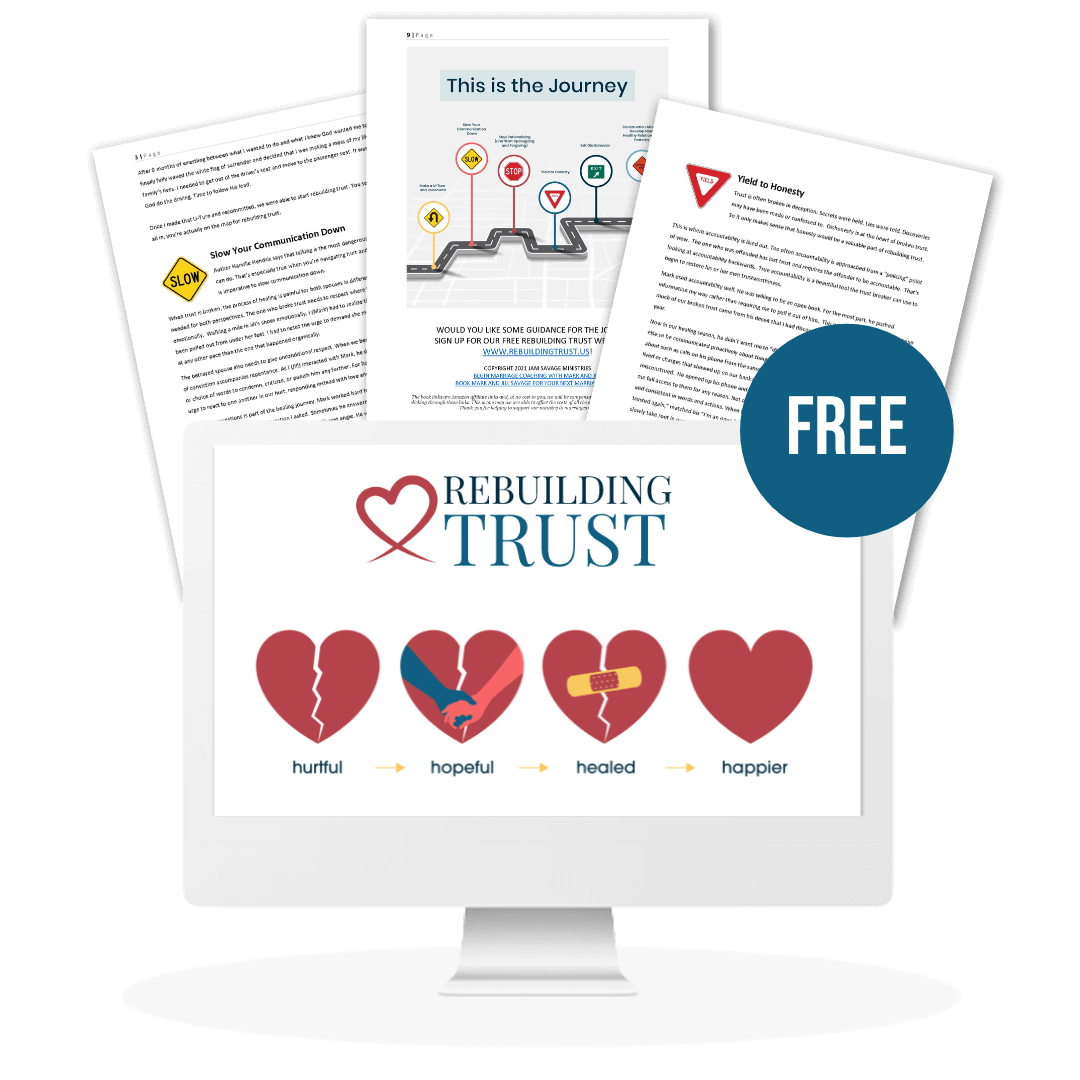
Jill: This process doesn’t happen by accident. Marriage is when two broken people enter into a relationship with one another. There is bound to be friction and struggles with even the best couples. That’s why we created our Rebuilding Trust Course to help provide the tools you need to communicate with your spouse and start trusting each other again. It’s also why we created our free Rebuilding Trust guide. Click here to access our 6-step guide to rebuilding trust, completely for FREE: