

Wouldn’t it be nice if there were an alarm that sounded when your relationship was headed for a crisis? Something clear and impossible to miss—like tornado sirens warning us that danger is ahead.
When our marriage was in crisis, I (Jill) could have said that Mark’s affair blindsided me. It’s true that there were many things about that situation I never could have been expected to predict.
If I’m being honest, though, there were signs long before Mark left that something was wrong in our marriage. I just didn’t realize how important it was to pay attention to them.
Even though our story had a happy ending, and we are now enjoying a 2.0 version of our marriage, it would have saved us a world of hurt and heartache if we had known what signs to look out for and addressed those issues head-on, rather than letting them fester and turn into a crisis.
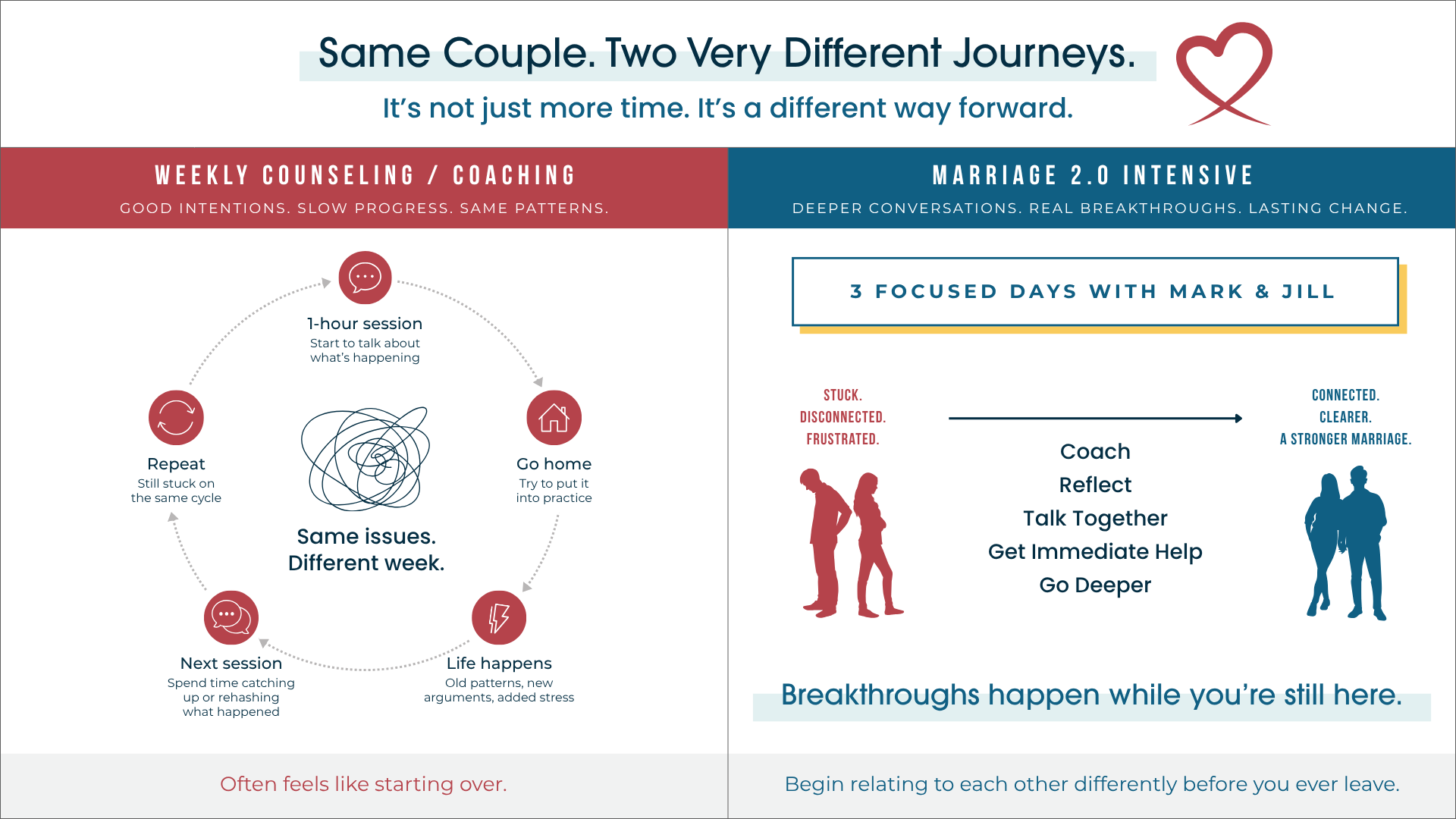
If you’re reading this, and you’re worried that your relationship could be drifting in the wrong direction, we would like to invite you to join us for a marriage intensive at our home in Normal, IL. Through an entire weekend of personalized support, we will help you diagnose what’s causing dysfunction in your marriage and give you the tools you need to make positive change—the kind that actually lasts after you go back home.
You might be where we were all those years ago: on the brink of calling it quits. Or your marriage may appear perfect on the outside, but deep down you know there are problems.
No matter where your marriage is at today, it’s worth your time to learn these 8 key signs your marriage is headed for trouble and needs some attention:
1) You no longer “date” your spouse.
Early on in your relationship, before vows, mortgages, and little ones, dating was how you spent the majority of your time together. You tried out new activities, went on fancy dinner dates, and enjoyed exciting adventures together.
Then at some point, reality hits, and you spend more time doing chores around the house and planning the week’s meals than having fun together.
But dating is more than a fun activity. It’s a time to connect with your spouse, to let them know you still enjoy their company, to pursue intimacy, and to focus on one another.
It can be challenging to remove the distractions of our busy lives for a night out, especially if you have demanding careers or children in the house. But a “date” now doesn’t have to look the same as when you were courting your spouse. It could be setting aside time after the kids are in bed to share a board game together or watch a TV show you both enjoy. Mark and I will often go on walks through our neighborhood together or share our favorite beverage on our porch to wind down before bed.
Whatever it looks like in your current season of life, the important thing is that you hit “pause” on the to-do list and focus on connecting with one another. Remember, the goal is progress over perfection. You will still have weeks when you’ll have to change the plan because one of you has a big project at work or your toddler was up all night with a cold—and that’s ok.
Want to enjoy more intentional dates with your spouse, but don’t have the time to plan them? We’ve done the hard part for you and planned them out. Check out our No More Perfect Date Night community.
2) You can’t seem to get aligned about how your time and resources are spent.
Does this seem like a familiar scenario? You get home from work on a Friday afternoon, ready to sit back, relax, and enjoy the weekend. Except you forgot that your child has a baseball game tomorrow, your parents asked to go out for lunch on Sunday, and the house is a mess that you promised to help tidy up.
Whether this occurs because of forgetfulness or because your spouse springs their plans on you at the last minute, it doesn’t feel good when your voice isn’t heard about how your time and resources are spent as a couple. When one person is primarily making all the decisions, it can feel like the other person’s wishes aren’t being considered.
In the 1.0 version of our marriage, Mark often felt like his opinion didn’t matter, which was a mindset that stemmed from his childhood. In our relationship, he eventually stopped vocalizing when he disagreed. At the time, it may have seemed like he was graciously avoiding conflict, but in reality, those unvoiced desires piled up and led to discontentment.
Now, we regularly have what we call a weekly marriage meeting. This is a time when we get on the same page when it comes to our marriage, our calendar, and important tasks. It ensures we feel like we are on the same team and are aligned in our priorities. Check out the blog below for more details about planning a weekly marriage meeting.
READ: How to Have a Weekly Marriage Meeting | #MarriageMonday
3) You fight over small things.
We all have those things our spouse does that push our buttons and irritate us to no end. It could be how they chew with their mouth open, the way they load the dishwasher, or how much they use the word “like” in their daily vocabulary.
While these habits can certainly be annoying and even appear to be the source of fights between you, more often than not it’s less about their “annoying” way of doing things and more about what’s going on inside us.
Much of what our spouse does that we perceive as “incorrect” can actually be chalked up to our own unvoiced expectations and differences in how things were done in our families growing up.
When these squabbles come up in your relationship, it’s important to ask:
- Do I have a preferred standard or way of doing things from my childhood that is clashing with my spouse’s way of doing things?
- Did I have an expectation of how this task would be done that was not met? Does the “how” of the task really matter?
- Am I taking the time to celebrate my spouse’s strengths, preferences, and unique way of approaching problems as an asset in our relationship?
So often, when these fights over small things occur, we are actually feeling the friction of two different approaches rubbing up against one another. Neither one is “right” or “wrong”; they are merely different.
When dealing with the harmless human habits that bug us but don’t really hurt us, what we need to use is the God tool of grace. We’ve learned that this approach results in less stress and more happiness for both the giver and receiver of grace.
4) Conflict is never fully resolved.
Fights are never finished, and old wounds continue to be reopened again and again. In your relationship, you are constantly keeping track of hurts and never fully moving past them.
This is a breeding ground for additional issues to pile up on top of one another in every argument. Every time you encounter a new conflict, suddenly the 5 or 10 past conflicts reappear.
We know how challenging it can be to rebuild trust after it has been broken. However, digging up past, presumably resolved hurts only serves to make that process take even longer, and sometimes it makes it impossible to achieve.
There’s a time and a place to address unresolved conflict, but once it’s been addressed and forgiven, it needs to stay that way.
5) You no longer trust each other.
Marriage is intended to be one of the closest relationships we can experience this side of heaven. It should be a place where we can help each other grow, bear each other’s burdens, and offer a safe space for our spouse to be their true self.
Once you stop trusting your spouse and vice versa, there is very little keeping your relationship together. If your trust has been lost due to a betrayal, it can be hard to regain again. We have an entire podcast series on how to heal from broken trust.
LISTEN: A 4-Step Roadmap for Healing from Infidelity and Broken Trust
An analogy we like to use in our coaching when explaining what it’s like to regain your spouse’s trust is that of a bathtub. After the bathtub of full of water (trust) has been drained due to a rupture, it takes time to refill it—one little spoonful at a time.
6) You blame one another instead of owning your part in conflict.
Even though Mark was the one who stepped out on our marriage, I can admit that I contributed to the dysfunction in our relationship.
All of us are human. This is not to say that you should let your spouse off the hook for ways that they have hurt you, but it’s important to start by looking inward. After all, your own behavior is the only thing you have complete control over.
Own how you responded in the conflict or perhaps your lack of response. Taking the time to reflect is essential to uncovering the root causes of recurring patterns in your relationship and stopping unwanted cycles. For example, there could be unaddressed issues from your childhood that are contributing to dysfunction in your marriage, and if this is the case, seeking individual help from a professional could be the step that makes the biggest difference in your relationship.
When we approach a conflict with an attitude that is seeking to win the fight and heap as much blame as you can on your spouse, that is an approach that can lead to the end of a relationship.
7) Intimacy is nothing more than sex.
While sex is an important part of intimacy, it isn’t the whole picture. We prefer to think of intimacy as the phrase “into me see.” It’s quite literally exposing the most tender aspects of yourself to another person.
If you have the physical act of sex in your relationship without any intimacy, then it has likely become more of a chore than an act of connection and love.
A loss of intimacy can happen for any number of reasons. Perhaps you’re new parents struggling to shift out of parent mode and into partner mode so you can connect genuinely. Maybe your spouse has stopped making an effort to connect leading up to sex. Regardless of the underlying cause, a lack of intimacy usually isn’t a challenge that exists in complete isolation from the rest of your relationship. Think of it as a canary in a coal mine, and use it as an opportunity to discuss what needs to change.
8) You let things fester rather than bring them up to your spouse.
On the surface, it may appear that you are “letting go of the small stuff,” but in reality, issues don’t go away when you sweep them under the rug. They smolder just under the surface, and you are constantly reminded of how much those issues irritate you and make you feel unloved in your relationship. This kind of thinking can lead us to believe dangerous ideas—such as the thought that the grass really could be greener in another relationship.
You might reason with yourself that it’s not worth starting an argument if your spouse isn’t going to listen or change anyways. It feels more painful to bring things to their attention only to have them disregarded.
One of the dangers here is that you can start to fantasize about how different things could be in a new relationship. You may even find yourself complaining about your spouse to someone else and finding solace in that friendship. While on the surface it may seem innocent enough, it’s a slippery slope that can easily transform into entering an emotional affair or even a physical one.
There are so many reasons why it’s important to keep an open dialogue with your spouse, even when it’s hard or scary. We like to say that marriage is like a rowboat. If you’re not rowing together, you’re drifting apart.
Did you spot any of these signs in your marriage? While there is no such thing as a perfect marriage, if one or more of these signs are present in your relationship, it could be a sign that your marriage is headed for trouble.
Our marriage reached the state of crisis because we didn’t take the time to address small things while they were still small. We like to refer to these as the “slow fades” that chip away at your marriage, and this is one of the tools we teach couples at our Marriage Intensives. We would love to help you on your journey if you’ve found yourself stuck and unsure how to move closer in your relationship with your spouse.
Our Marriage Intensive is a one-of-a-kind investment to resolve existing conflict, equip you with tools to address future issues, and to rediscover the love you have for one another. This weekend-long retreat gives you access to our full attention for over 20 hours of focused coaching.
We coach you through what’s happening, then intentionally give you time to talk together and reflect individually. When something new surfaces, you don’t have to wait to address it. You bring it right back into the next session and keep working. Click here to learn more about our 2.0 Marriage Intensive or to save your spot.